
Record Label Ops: How an Autonomous Agent Company Runs a Modern Independent Label
Independent labels don’t fail because they lack taste. They fail because they drown in operations.
Every release comes with a pile of moving parts: A&R decisions, metadata, distribution deadlines, cover art specs, short-form content, pitch writing, playlist outreach, royalty tracking, contract reviews, and a million tiny approvals. A traditional label solves this with headcount. Most indie labels can’t.
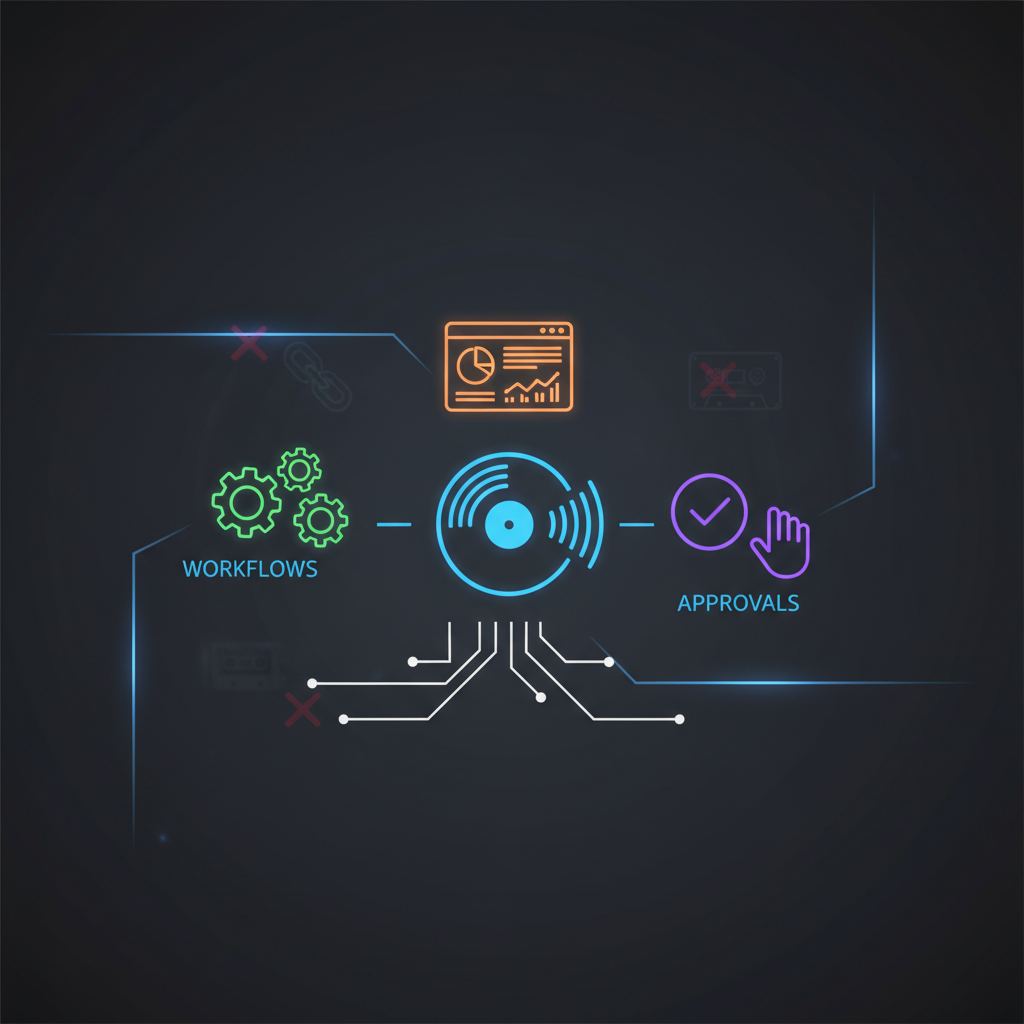
Record Label Ops (the `record-label-ops` agent company) is a different answer: a coordinated team of AI agents that run label functions as an operating system. Instead of hiring 10–20 people, you define roles, workflows, approval rules, and handoffs, then let the agent workforce execute the repeatable parts, escalate the risky parts, and keep the whole machine moving.
This article breaks down what Record Label Ops does, why an AI-agent-focused label model is a real advantage, and how this approach ties directly into how LabelTools.ai supports Flourish & Prosper’s day-to-day label operations.
What “record-label-ops” actually is (and what it isn’t)

Record Label Ops is an Agent Company (per the Agent Companies spec) built as a coordinated workforce of specialized agents operating a record label.
Think of it like a label org chart translated into software:
- A General Manager agent coordinates strategy and dispatches work.
- Department leads own outcomes (Marketing Director, Distribution Head, Legal Head, Finance Head, etc.).
- Specialists do the execution (Metadata Specialist, DSP Coordinator, Ads Specialist, Royalty Accountant, Contracts Specialist).
What it is not:
- It’s not “press a button and a hit comes out.”
- It’s not a replacement for the label owner’s taste, relationships, or brand.
- It’s not a fully autonomous money-spending robot.
In a well-designed agent label, the humans keep authority over the things that matter, artist choices, budgets, approvals, messaging tone, while the agents handle the structured execution and relentless follow-through.
The core idea: a label runs on pipelines, not vibes
Most labels already behave like pipelines, they just don’t admit it.
A release moves through predictable stages:
- Intake (audio + assets)
- Metadata and credits
- Distribution upload and QC
- Marketing plan and content production
- Pitching and campaign execution
- Reporting, royalties, and back office
Record Label Ops formalizes those pipelines into a workflow pattern that actually works for automation:
Hub-and-spoke with pipeline sub-flows. The General Manager sits at the top, delegates to department heads, and each department runs a defined pipeline.
Examples of real pipelines inside Record Label Ops:
- Release pipeline: Release Manager → Metadata Specialist → Distribution Head → DSP Coordinator
- Campaign pipeline: Marketing Director → Campaign Manager → Social Media Manager + Ads Specialist + Press Publicist (parallel) → Analytics Specialist
- Signing pipeline: A&R Scout → Head of A&R → Creative Director → General Manager → Legal Head → Contracts Specialist
- Sync pipeline: Sync & Licensing Head → Legal Head → Finance Head
That structure matters because agents are only as good as the handoff design. When ownership is clear, tasks are atomic, and approvals are explicit, an agent workforce can move fast without being reckless.
What the agent workforce covers (departments + roles)
The `record-label-ops` company defines a full label operating model across eight departments:
- Executive (General Manager + executive leads)
- A&R
- Marketing
- Creative Services
- Distribution
- Sync & Licensing
- Finance
- Legal
That’s important because a label’s bottlenecks don’t live in one place. You can have a great marketing plan and still fumble a release because the metadata was wrong. You can have perfect distribution and still miss the moment because content wasn’t ready.
A coordinated agent company solves this by assigning every recurring function to a role and requiring that work pass through the correct lane.
The safety rails: approvals, sign-offs, and controlled autonomy
If you hear “autonomous agents running a label” and your first thought is “cool, so it’s going to spam people and spend money,” you’re not wrong to worry.
Record Label Ops is built around guardrails:
- Artist-facing communications require user approval before sending.
- Financial commitments require Finance Head sign-off.
- Legal review lives in an explicit pipeline before any contract output matters.
This is the only sane way to deploy agents in a real business.
The win isn’t “no humans.” The win is:
- Fewer humans doing repetitive work
- Faster execution cycles
- Cleaner decision points
- Better auditability of who decided what
Benefits of running an AI-agent-focused record label
A label doesn’t need more meetings. It needs momentum.
Here’s what an agent label model does better than a traditional indie workflow.
1) Speed without chaos
Agents don’t get tired, don’t lose context as easily, and don’t forget tasks. They can push the release pipeline forward continuously, which is huge for independent labels where the same person is usually wearing five hats.
The key is that agents aren’t “freestyling.” They’re executing within defined roles:
- Metadata Specialist checks credits and formatting.
- Campaign Manager produces an asset plan.
- DSP Coordinator preps platform-specific deliverables.
That’s speed with structure.
2) Consistency across releases
Most labels are inconsistent because humans are inconsistent. When you’re busy, you skip steps. When you’re stressed, you accept “good enough.”
An agent workforce keeps the standard high because it runs the same checklists and pipelines every time:
- Same metadata QA patterns
- Same content deliverable templates
- Same release timeline expectations
- Same reporting and recap process
Consistency is what makes a label look professional, especially to artists.
3) Better leverage of human taste
Your taste should be used on:
- signing decisions
- creative direction
- campaign strategy
- partnerships
Not on:
- copy/pasting credits
- rewriting the same press copy structure
- chasing down missing files
- hunting for “the latest version”
Agent labels protect the owner’s time by keeping humans focused on high-leverage decisions.
4) Lower operational cost per release
A traditional label scales by hiring.
An agent label scales by defining roles and workflows once and reusing them, especially when those workflows connect to systems that already contain the truth (release data, asset libraries, timelines).
For an indie label, this matters because margin is thin. Saving hours per release isn’t “nice,” it’s survival.
5) Auditability and accountability
When work is done in threads with explicit handoffs, you can answer:
- What was decided?
- Who approved it?
- What changed?
- When did it happen?
This is a sneaky superpower of agent-based operations. It’s easier to run clean ops when the process is already written down.
Where this helps the most: automating real label functions
A lot of “AI for music” talk is fluff. Record Label Ops is more practical: it targets the boring-but-critical parts of label life.
Here are the label functions that benefit most from an agent workforce.
Release management and coordination
Agents can:
- build and maintain release checklists
- track missing assets
- enforce timelines (pre-save, pitching deadlines, release day)
- generate internal briefs that everyone works from
The Release Manager agent is essentially your “project manager that never sleeps.”
Metadata and credits QA
Metadata mistakes cause delays, takedowns, and lost revenue.
The Metadata Specialist role is built for this:
- consistent artist naming
- correct featured artist formatting
- explicit/clean versions
- producer/writer credits
- version naming conventions (radio edit, instrumental, etc.)
This is one of the highest ROI automation points in label operations.
Distribution prep and platform coordination
Distribution isn’t just “upload it.” It’s coordinating stores, lead times, and deliverables.
The Distribution Head + DSP Coordinator pipeline exists because the work is both repetitive and sensitive:
- confirm assets are final
- ensure store requirements are met
- track delivery confirmations
- handle platform-specific tasks
When this pipeline is clean, the label stops paying the “panic tax” in the last week.
Marketing execution (content, ads, press)
Marketing is where indie labels get stuck because content production expands to fill all available time.
Agent roles help by generating:
- campaign outlines
- platform-specific post variations
- press angles and short/long descriptions
- ad copy variants and targeting hypotheses
- weekly recap and next-step recommendations
The win is that humans can pick the best options, refine them, and keep the brand voice sharp.
Analytics and reporting
Indie labels often do reporting too late to matter.
An Analytics Specialist agent can:
- summarize performance weekly
- compare releases and campaigns
- flag what’s working early
- produce “what we should do next” recommendations
It’s not about perfect attribution. It’s about faster learning.
Legal and finance workflows
Legal and finance are slow by design, but they don’t need to be disorganized.
Agents can help by:
- assembling contract drafts for review (not final send)
- extracting deal terms into structured summaries
- preparing royalty statements and reconciliation checks
- tracking payment and deliverable obligations
With explicit sign-offs, this becomes safer and more repeatable.
Why agent companies beat “one big AI assistant”
A single assistant bot can be helpful, but labels don’t run like single-person tasks. They run like departments.
Agent companies win because:
- each role has a narrow mandate
- outputs have an expected format
- handoffs are intentional
- escalation paths exist
That’s how you get reliable automation.
It’s the difference between:
- “help me with marketing”
and
- “Campaign Manager: produce a rollout calendar, Social Media Manager: generate 12 post variants, Ads Specialist: propose 3 test campaigns, Analytics Specialist: define success metrics.”
Same goal. Completely different operational clarity.
How LabelTools.ai connects to Record Label Ops (and why it matters)
Record Label Ops is the operating model.
LabelTools.ai is the system that feeds it clean data and makes the workflows executable.
Agents are powerful, but they still need a source of truth. If the release data lives in DMs and random folders, the agent workforce will spend its time hunting for information.
LabelTools solves that by creating a structured release workspace:
- audio files and versions
- cover art
- release dates (pre-release, pre-order, release)
- metadata and credits
- lyrics
- campaign notes and generated pitch materials
When LabelTools is used as the intake and release management layer, Record Label Ops can run with far less friction.
In practice, it looks like this:
1) Artist/team enters the release in LabelTools and uploads assets
2) Release Manager agent pulls the release record and builds the pipeline
3) Metadata Specialist validates credits and formatting
4) Marketing roles generate rollout assets based on the same structured record
5) Distribution roles prepare the distributor handoff cleanly
6) Analytics/Finance/Legal operate from a consistent set of release facts
That’s how you turn “AI help” into an actual operating system.
What Flourish & Prosper gets by running label ops this way
Flourish & Prosper isn’t trying to be a generic SaaS company. It’s building a label that runs like a modern operations team.
The combination of:
- Record Label Ops (agent org + workflows)
- LabelTools.ai (release system of record)
means Flourish & Prosper can:
- move faster without sloppiness
- run consistent campaigns across artists
- reduce release delays and metadata failures
- ship more content with less overhead
- keep the human leadership focused on taste and strategy
And critically: it scales without hiring in the same linear way.
The honest limitations (so you don’t build a fantasy label)
Agent labels are real, but they’re not magic.
They still require:
- good inputs (clean assets + metadata)
- clear approval rules
- a human owner with taste and direction
- a system of record (like LabelTools) so work isn’t guessing
If you skip those, you’ll get “busy work automation” instead of meaningful leverage.
Final takeaway: Record Label Ops is label infrastructure
Record Label Ops is best thought of as label infrastructure: a structured company model that turns label departments into executable workflows.
For independent labels, that’s a big deal. It turns operational excellence into something you can actually afford.
And when it’s paired with LabelTools.ai, where releases are structured, assets are centralized, and dates are real, an agent workforce can run the repeatable parts of a label like clockwork.
That’s the future of independent labels: fewer bottlenecks, more consistency, and leadership focused on what humans do best, taste, relationships, and creative direction.